The New Era of Industrial AI: Decentralized, Adaptable, and Hardware-Agnostic
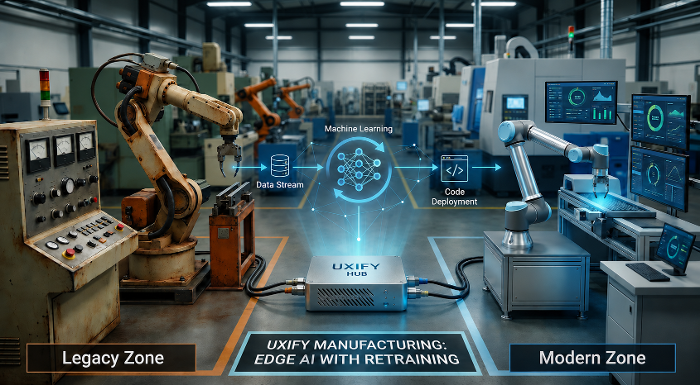
Industrial manufacturers are under growing pressure to modernize while keeping costs, security, and sustainability in check. But in many factories, that is easier said than done. Older equipment is often difficult to connect to newer systems, and outright replacement is not always practical.
A major problem facing manufacturers is integration of diverse equipment, and integration of legacy equipment is especially difficult. In many cases, "hacking" into a complex, older device is technically unfeasible. From a business perspective, forcing invasive modifications of equipment can instantly void manufacturer warranties, leaving operators with a high-stakes gamble: leave mechanically sound assets completely isolated, or risk losing critical legal protections by attempting to force compatibility. Operators are therefore faced with a potentially fragmented environment, leading to inefficiencies and workflow disruption.
Simultaneously, data generation on the factory floor is rapidly accelerating. In this environment, artificial intelligence (AI) solutions are likely to require constant model re-training to adapt to rapidly shifting manufacturing realities. Central re-training requires continuous pumping of massive raw data sets from thousands of factory floor sensors to a centralized cloud database. This creates severe data security/sovereignty and intellectual property (IP) vulnerabilities, high data transmission costs, intermittent latency spikes, and an expanded carbon footprint.
Therefore, non-invasive integration is becoming a baseline requirement, particularly for environments with high-value legacy assets. At the same time, intelligence is moving closer to where data is generated, with localized model adaptation reducing reliance on continuous cloud connectivity. Minimizing data movement into the cloud is emerging as a key principle for balancing performance, security, and sustainability.
The UXify Manufacturing solution from SimpleWay Technologies creates a unified workspace across diverse equipment by adapting the patented UXify hub and unified operating system for industrial environments. The platform orchestrates direct endpoints, bootable units, and legacy hardware through intermediary proxy devices that safely connect resource-constrained assets without invasive modifications. UXify Manufacturing utilizes edge AI with model re-training, where the local UXify hub learns from data on-site to continuously refine model and agent parameters. Only updated model and agent parameters are transmitted to a central aggregator for global optimization. This local-first approach curbs cloud-bound transit, which enhances data security/sovereignty, reduces IP risks and lowers carbon emissions. UXify Manufacturing reduces digital transformation cost by using proxies to enhance legacy device lifetime, successfully aligning advanced edge intelligence with circular economy goals.